
My husband and I have declared our independence from at least one cable company. After years of griping about the ever rising cost plus poor customer service, we’ve finally cut the cord. We’ve canceled our TV! Take that, Spectrum!
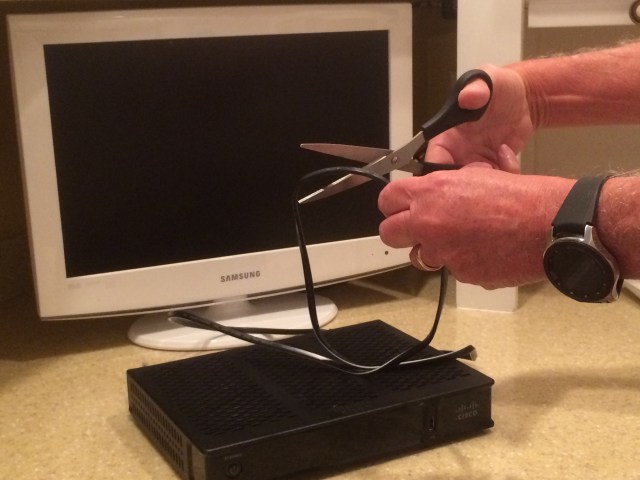
That’s a cable box you see in the picture above, but my husband is not really, actually cutting the cord. Oh no, I had to find a UPS store and mail the box (with an undamaged cord, of course) to the cable company so I wouldn’t continue to be charged a monthly equipment fee. Actually, there were two boxes…and two remotes.
To be fair, I didn’t pay for shipping, but still, how inconvenient to have to haul in equipment to quit the cable company.
Spectrum, formerly Time Warner (which, I swear, still owes me money but that’s another story), was the cable company at our house at the beach. Those ugly, cumbersome boxes were part of how the system worked. We had to have one for every single stinking TV set to work, and we were charged a monthly fee for every stinking box. At one time I had four until I cut back to save money. That meant I then had non-working televisions.
Spectrum is still our Internet company at the beach (can we say “monopoly” here), since we can’t live without our iPads. But my husband and I have discovered a whole new way of watching television.
Ta da! Subscription TV!
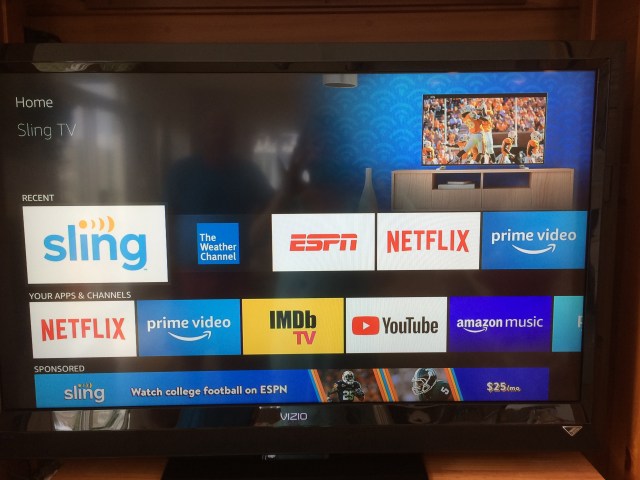
Maybe a year ago (two, three?), I heard about Netflix. I wanted to watch the series “Orange Is the New Black” since I’d read the book. It aired only on Netflix. I got online, Netflix at the time was just $10 a month, and I signed up.

After a season of female prisoners, I moved on to shows I could watch with my husband: “The Crown,” “Breaking Bad,” “Better Call Saul,” and “Stranger Things.” We’re currently in the middle of “Halt and Catch Fire,” a series about the early crazy days of the personal computer industry (the ’80s). Wow, some great television and NO commercials.
Having an Amazon Prime membership, we learned, qualified us for Prime Video television. We’ve enjoyed “The Marvelous Mrs. Maisel” and are eager for the next season of this show. And I’ve watched a bunch of Masterpiece Theatre.

The one gap, though, a big one for my husband especially, was sports. That’s where cable had us. Until we heard about Sling TV.
Labor Day weekend found us at the beach desperately attempting to order/subscribe/install Sling TV. We wanted to watch the NC State versus East Carolina football game. We learned not only did we have to sign up for Sling TV, but we also needed the Sports Extra add-on.
Fred and Wilma Flintstone (a.k.a. my husband and I) succeeded with only minutes to spare before the noon kickoff. The game was a bust for us Pirate fans, but hey, we did have a victory in that we’d said adios to the cable company.
At least at the beach. We haven’t yet cut the cord with Suddenlink, our cable company at home. We probably should–we’re finding we watch more stuff on our subscription channels than we do on cable!
Cable versus subscription TV: what are you doing?





 I see cardinals, wrens, and doves, but my favorite to watch are the tiny hummingbirds. They’re attracted not only to a feeder I fill with sugar water but also to the blooms of the blue and black salvia (pictured in the bottom left corner above) and the flowers of the larger hosta.
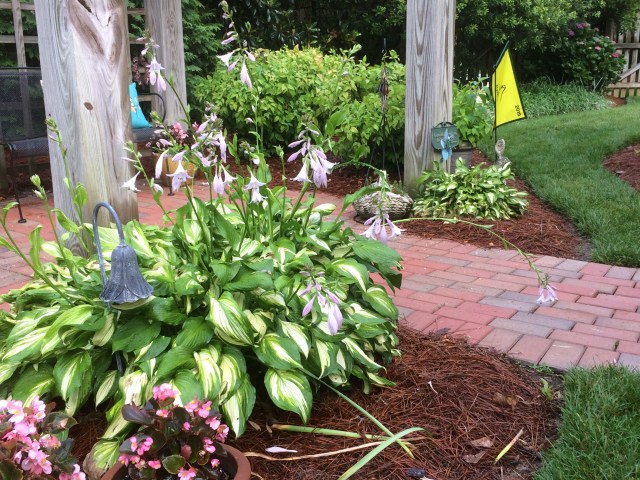 This year my hosta on the left in front of the gazebo is so much bigger than the other one in front of the gazebo on the right. I don’t think the smaller one intends to bloom either. Last year, both were about the same size, and both had flowers. Mother Nature can be moody.
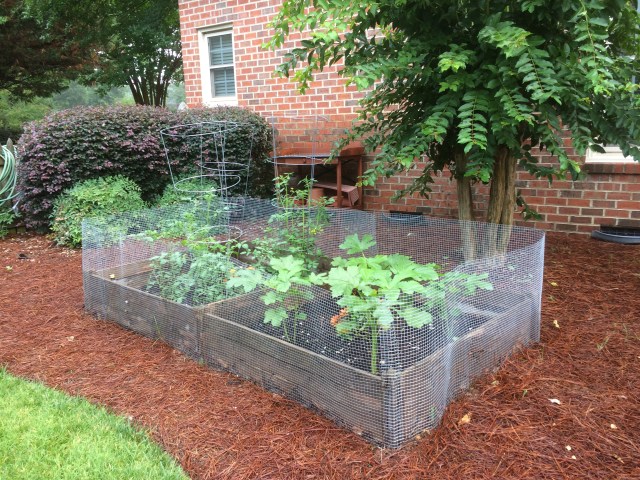
 As I mentioned, the garden, if I may call it that, is growing. I have four hills of cucumbers and four of squash, planted along the edge of the shrubbery. I don’t think the landscaping looks bad with the addition of the vegetables, do you? I’ve already picked my first cucumber. Sooo much tastier than what’s in the grocery store.
 The rest of the garden is behind a wire fence to prevent the resident rascally rabbit from helping himself (or herself?). For some reason, this critter doesn’t eat squash and cucumbers, but I have to protect my okra, tomatoes, and the couple of zinnas I throw in for fun.
 I also try to deter my rabbit by providing it with scattered bird seed. It’s quite entertaining watching the bunny eat. It’s pretty brave and doesn’t hop away as long as I stay on my porch.
 I’m not sure where the rabbit lives–maybe in this bed of liriope (monkey grass) that’s growing like crazy. Yes, those are deer antlers (I’m married to a hunter) gracing my planters. I also went wild this year with a can of bright pink spray paint, adding color to a pair of rusty yard-art birds.
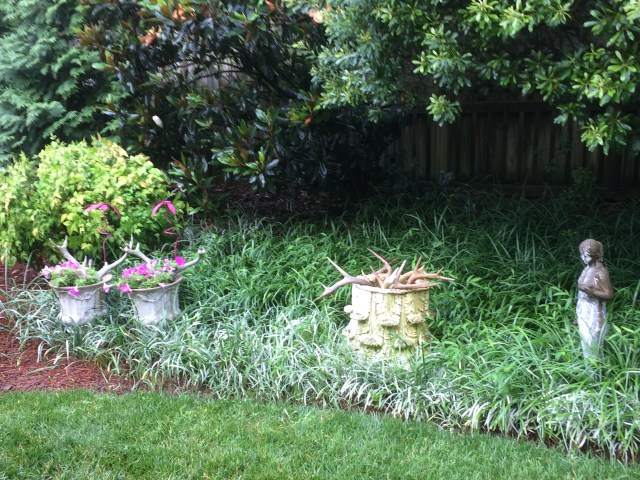 I used the same paint on a brown decorative bird cage that had seen better days. The pillows on the bench and the blue chair pads were bought last summer at Walmart for only $5.00 each. They spent the winter in the garage and are now good for a second season.
 Most of the time, I’m not sitting on my back porch looking at the yard by myself. My husband of 42 years is there as well. I was thinking of him the other year when I bought this plaque in a garden shop in Wilmington, NC.


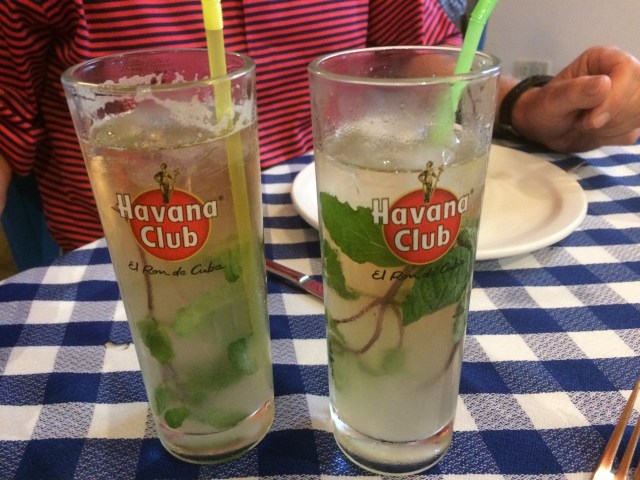
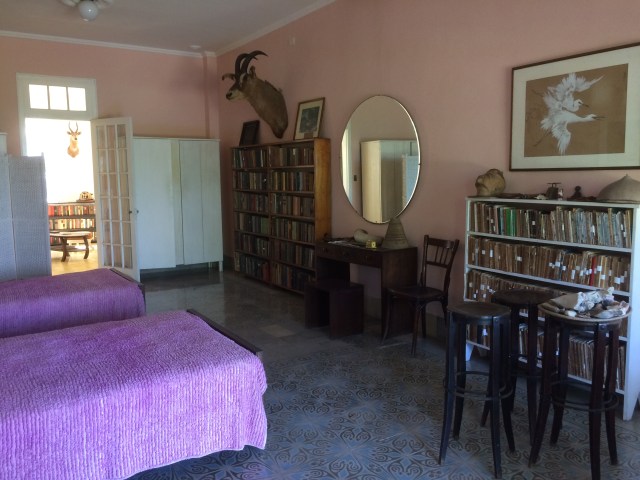 Another famous landmark I visited in Cuba doesn’t look like anything special, just an expanse of sandy beach on the south coast. It was here, however, at the Playa Giron that the Bay of Pigs invasion took place. Nearby is a museum, which, as you can imagine, gives a definite pro-Castro slant to the events surrounding the CIA-backed, failed military invasion to oust the new communist government.
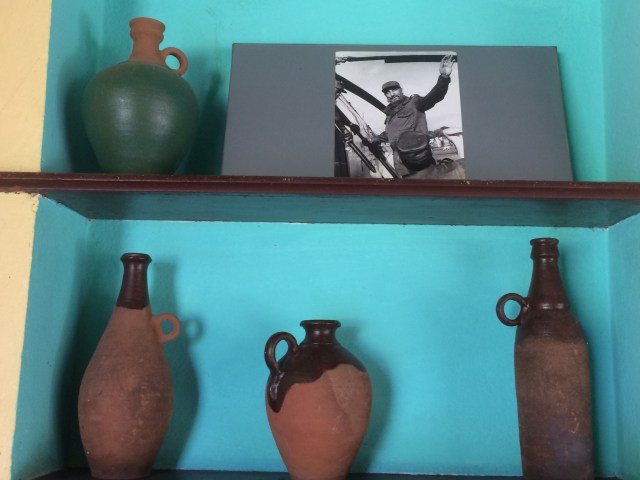
 Speaking of Castro, I expected to see his picture in government buildings and perhaps on billboards. In fact, he was all over the place along with his buddy Che Guevara. It was a little unexpected, though, to find his picture nestled with the pottery at the King Ranch, a 35,000-acre cattle spread seized by the government in 1959 in the Camaguey Province.
 At the ranch, our American group was invited to see a few rodeo acts, where I encountered another surprise: the display of the American flag alongside the Cuban flag before the show began.





 Patsy Pridgen